
Autism affects 1 in 50 school aged children.
Autism is the fastest growing developmental disability in the U.S.
1 in 68 children is diagnosed with an Autism Spectrum Disorder, and 1 in 42 are boys.
Studies in Asia, Europe, and North America have identified individuals with an autism spectrum disorder with an average prevalence of about 1%.
1 in 6 children in the U.S. has a developmental disability, ranging from mild disabilities, such as speech and language, to more serious ones.
As of 2005, the average annual medical costs for a child with autism was 6 times higher than costs for children without autism, roughly $10,709 per child.
In addition to medical costs, intensive behavioral interventions for children with autism costs on average $60,000 per child, per year.
Autism spectrum disorders occur in all racial, ethnic, and socioeconomic groups.
Research shows that early intervention is critical.
Intensive early intervention during a child’s early years maximizes future educational opportunity.
The diagnosis of autism most frequently does not occur until after age 4; parents often recognize a child’s developmental delays before a child is formally diagnosed.
According to experts, intervention should occur between 25-40 hours per week; most school districts and families cannot financially support this.
Parental involvement in early intervention is crucial to the outcome of a child’s progress.
Approximately 67 million people are affected by autism around the world; LifeRaft can help each and every one of them.
Why?
According to the CDC, 1 in 68 children born today is diagnosed on the autism spectrum. For them, and for their families, there are few educational options and treatment modalities, as well as very little financial support. The costs of inaction and the cost of inappropriate action are enormous… and inexcusable. This fact has lingered for decades, despite a rise in the incidence of autism and the reality that more children will be diagnosed this year with autism than with AIDS, diabetes and cancer, combined. The autism community receives only a fraction of the funding that these other children (with other childhood illnesses and disabilities) receive. The families of individuals with autism receive little to no direct assistance whatsoever. Individuals with autism, their parents, families, educators and facilitation partners need early intervention, meaningful change, purposeful options and affordable help. They need practical solutions and advocacy based in action. The autism community needs the right leadership, the right plan, an effective system and framework by which to thrive, and the kind of empowerment that will guide each and every individual affected by autism – no matter what their age - on a journey to excellence.
Why?
Applied Behavioral Analysis (ABA) remains the most empirically supported educational and behavior-centered teaching approach for individuals on the autism spectrum. When a quality, organized, and well-implemented ABA curriculum is administered to young children with autism, they are more likely to effectively mainstream and to meaningfully assimilate into more typical educational settings, as well as become more productive and functional members of society. The costs of ABA, however, can be exorbitant, and precious few families are prepared to bear its financial burden. For the overwhelming majority of families affected by autism, educational options include more generalized special education within a public school environment. For a very slim, but fortunate minority, private schools or home-based programs offer transformative help. Of these options, whether private or public, top-notch ABA programs are incredibly difficult to attain and the I.E.P. (Individualized Education Plan) process can be grueling, expensive, exhausting and even futile. Because ABA is considered, by many, to be the gold standard for educating children with autism and other learning differences, top schools across the U.S. and beyond have tried to incorporate ABA methodology into their curriculum. Sadly, however, these programs are often poorly administered by therapists and other educators. In addition, the geographic availability of ABA is sparse and splintered. Perhaps most unfortunate of all, ABA can cost upwards of $75K-$100K per year per child, a steep budget most families – and schools – cannot bear. As a result, children receive alternate educational approaches, often with low expectations of progress, weak guidelines, and little-to-no standards of effectiveness. Given a different set of user-easy tools with which to work, at a highly affordable price, and with expert guidance, these same families and schools would likely be able to successfully implement ABA for their learners. Lastly, while some measures for autism insurance reform have recently been taken, state mandates offer little practical direction, assistance or consistent support, frequently capping lifetime expenditures and sorely limiting coverage. For those affected by autism, there has been a sweeping performance failure of the greatest magnitude. As long as ABA-based therapy remains a critical component in the life success of a person diagnosed on the autism spectrum, a delivery system for the best that ABA has to offer needs to be in reach of anyone who seeks it for their child, affordably and regardless of someone's geographic proximity to top consultants.

Why?
The value proposition to the learners, families and other users of the LifeRaft program is significant. There is, however, an equally-compelling value proposition to school districts and administrators. The cost of materials, tools, training and consultants to organize a structured ABA-based program is considerable. Man-hours of lengthy I.E.P. meetings and the resultant cost of attorneys can be considerable, as more and more parents advocate for effective services. Compliance with Federal I.D.E.A. requirements is also of primary importance to school district officials. The LifeRaft system is designed with all of these things in mind, and much more. Most importantly, learners deserve the kinds of quality solutions that are based in science, proven to be most effective, organized and successful. The costs of mediocrity are far-reaching and inexcusable. Millions of children deserve real solutions; thankfully, solutions are here.
Why?
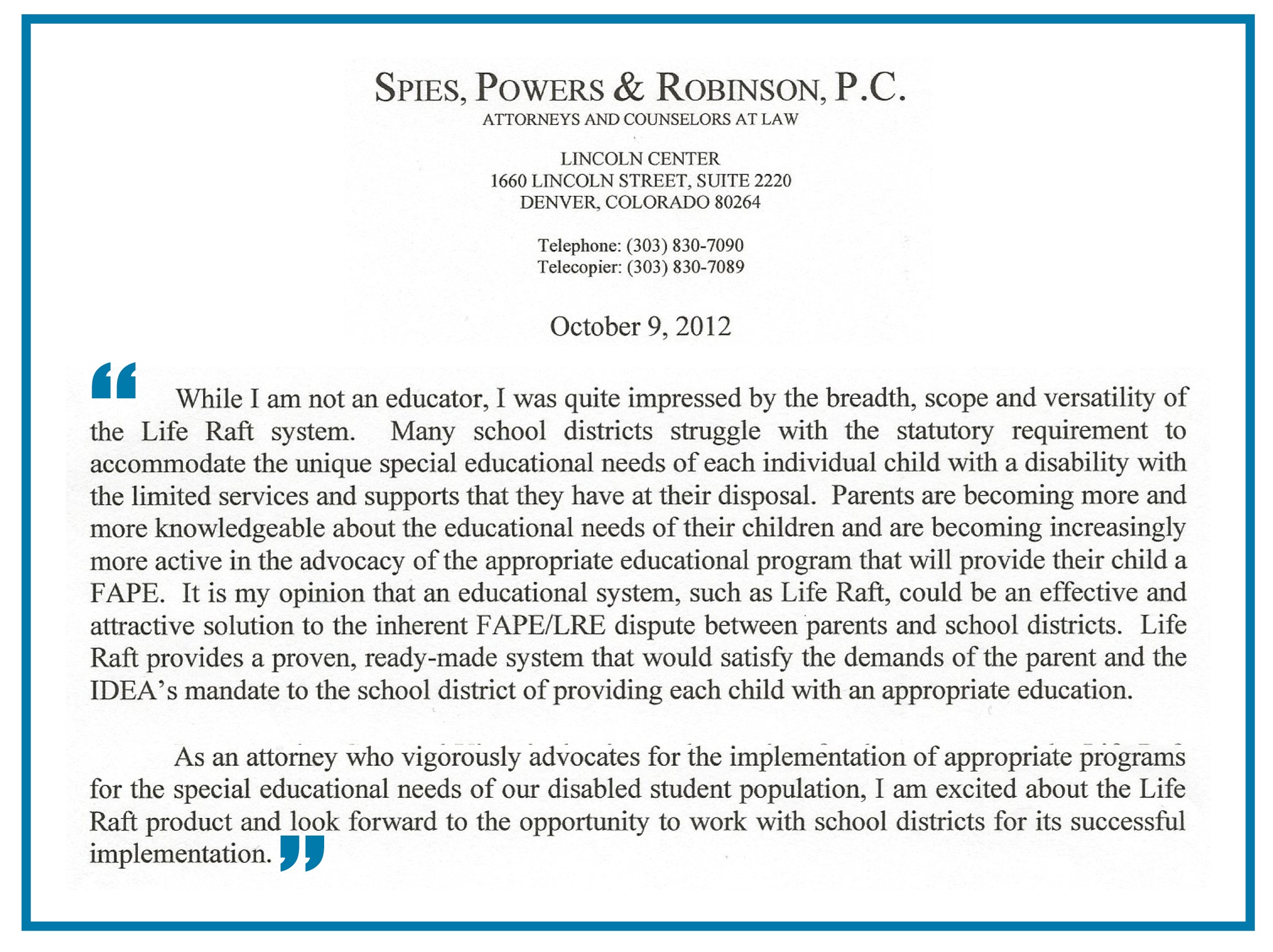
Jack D. Robinson, one of Colorado’s most distinguished and successful attorneys in the field of autism advocacy, thoroughly reviewed the LifeRaft system. He validated the system itself, as well as the value it brings to parents and schools. He underscored other parts of its key strengths – namely, the solutions it offers toward the fulfillment of Federal mandates and the solutions it provides for growing disputes regarding a free, appropriate public education (FAPE) and debates surrounding a least restrictive environment (LRE). These are two particularly contentious matters in the world of special education, especially for children with autism. For parents of individuals on the autism spectrum, attaining services becomes easier when they know exactly what those services should look like. LifeRaft cuts through such ambiguity and provides a clear, definitive and powerful plan of action as well as the tools, materials and means by which to implement that plan.
Why?
Children with special needs can learn to read through music, board games and step-by-step methods that are multi-sensory and fun! Expeditions to Excellence: A Fun and Friendly Phonics Safari will guide every LifeRaft learner to his or her individual level of reading success. Special data tracking forms, specifically designed to be used in conjunction with the LifeRaft curriculum, will record mastery at every level. To review the Expeditions to Excellence Reading System, visit www.BeExcellent.com and watch the introductory videos on the home page. It’s the most comprehensive, fun and effective phonics-based reading system ever designed!